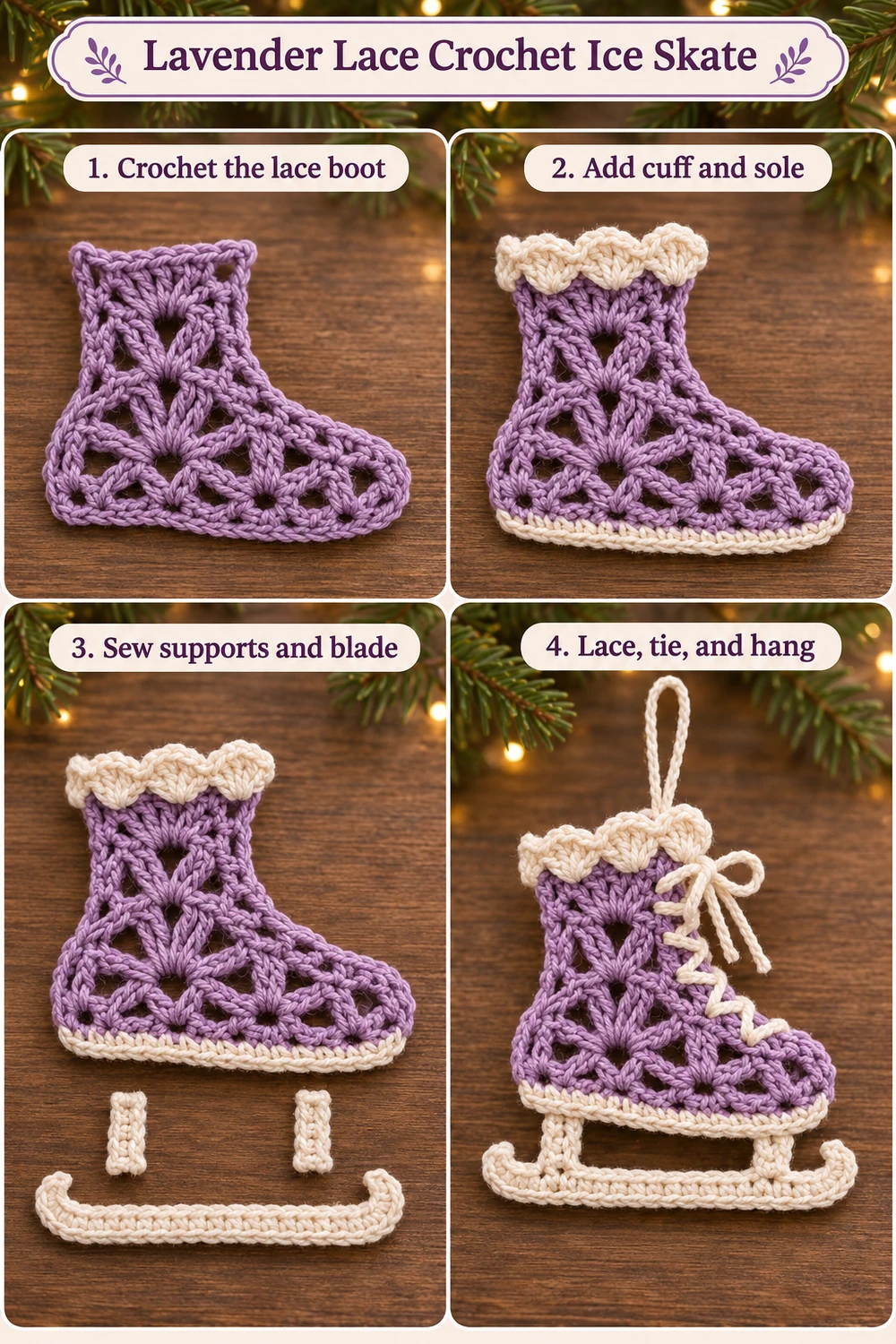
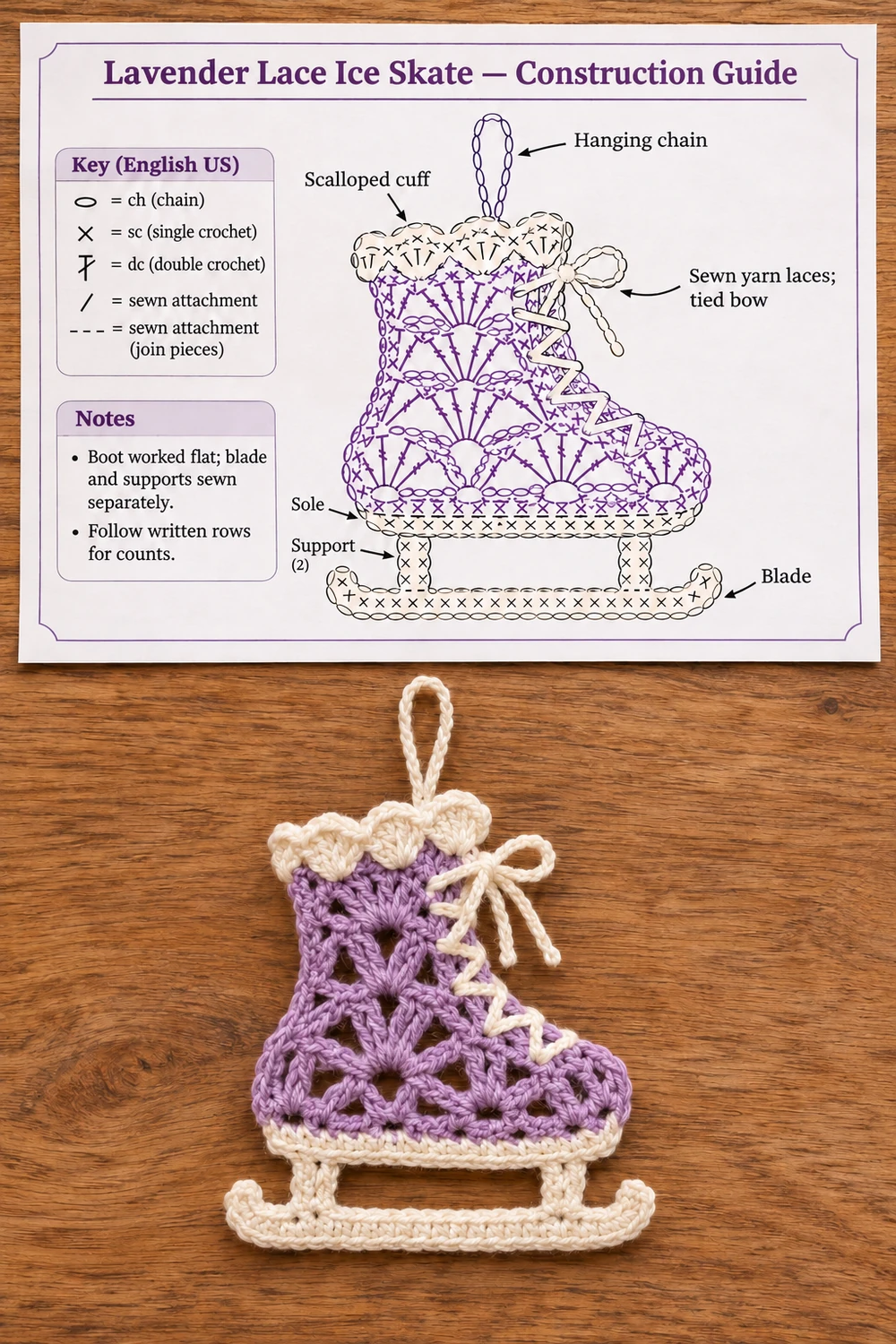
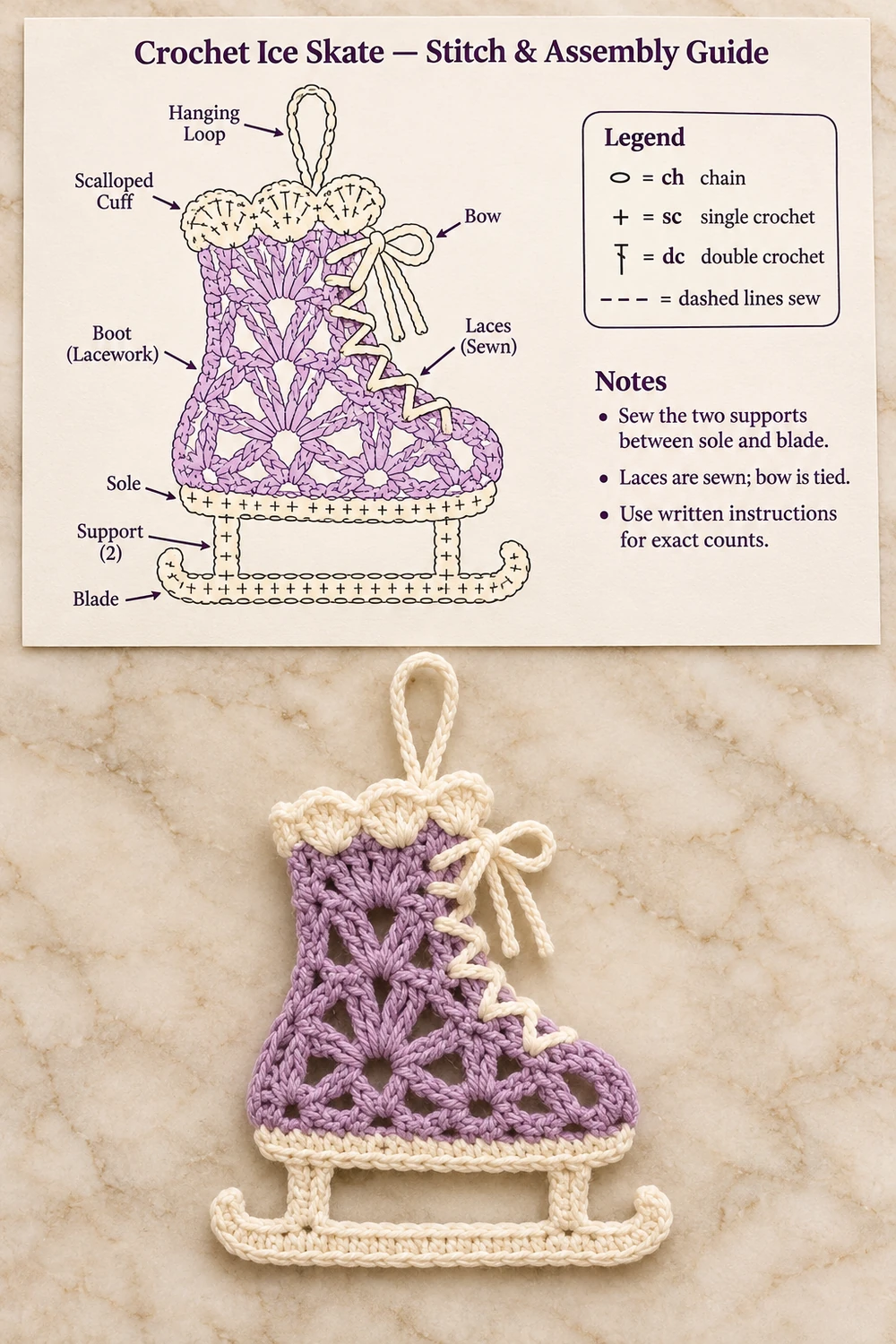
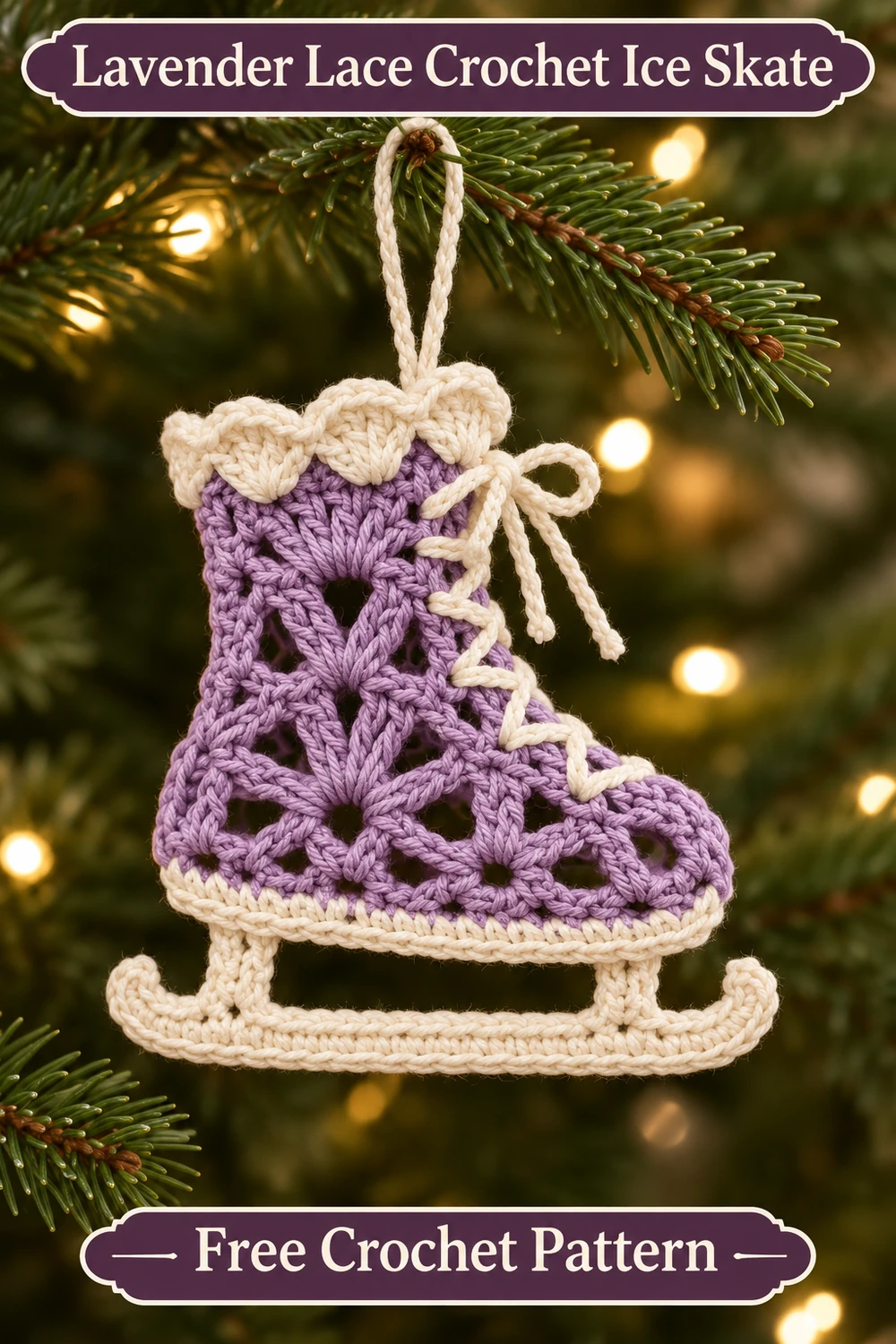
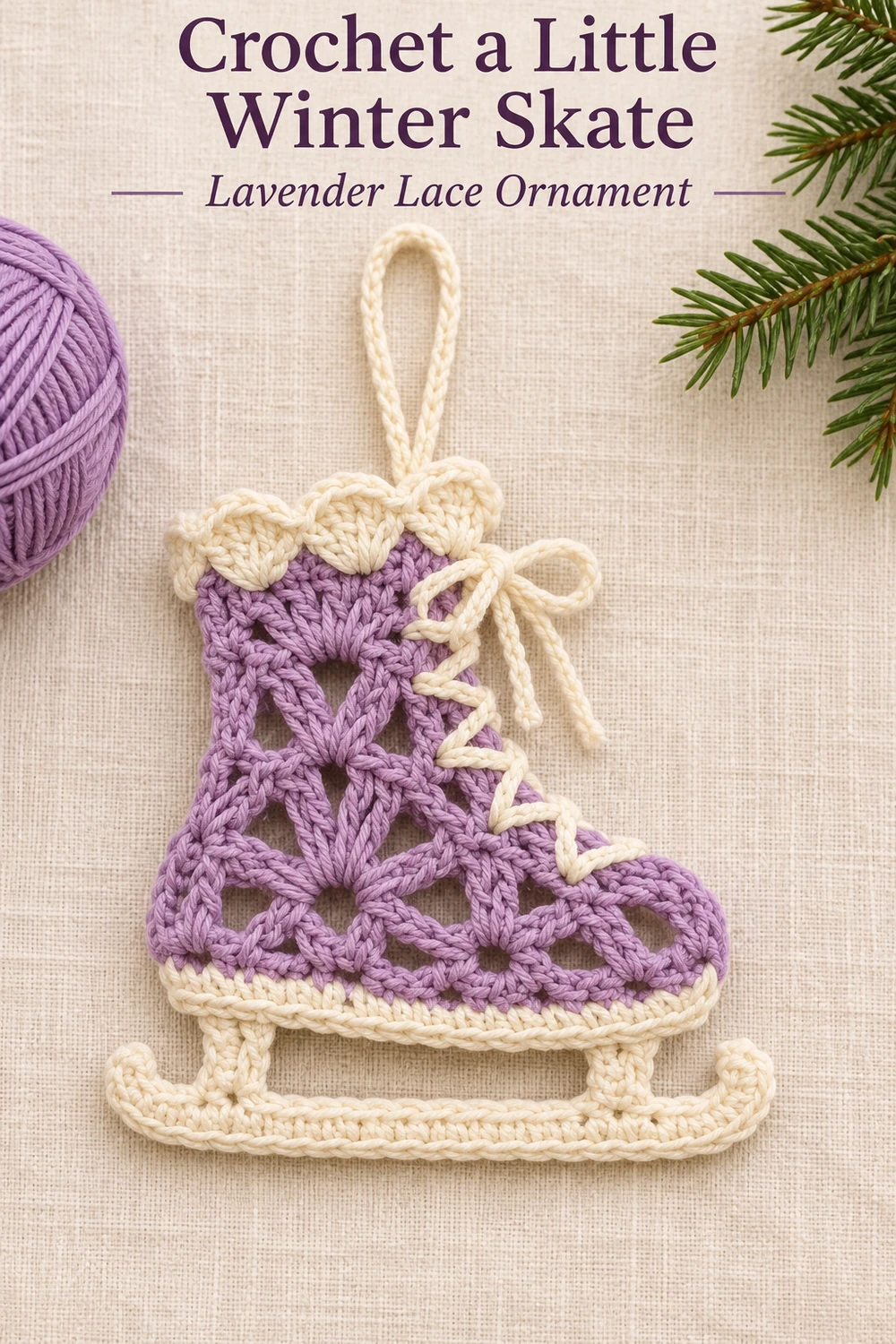
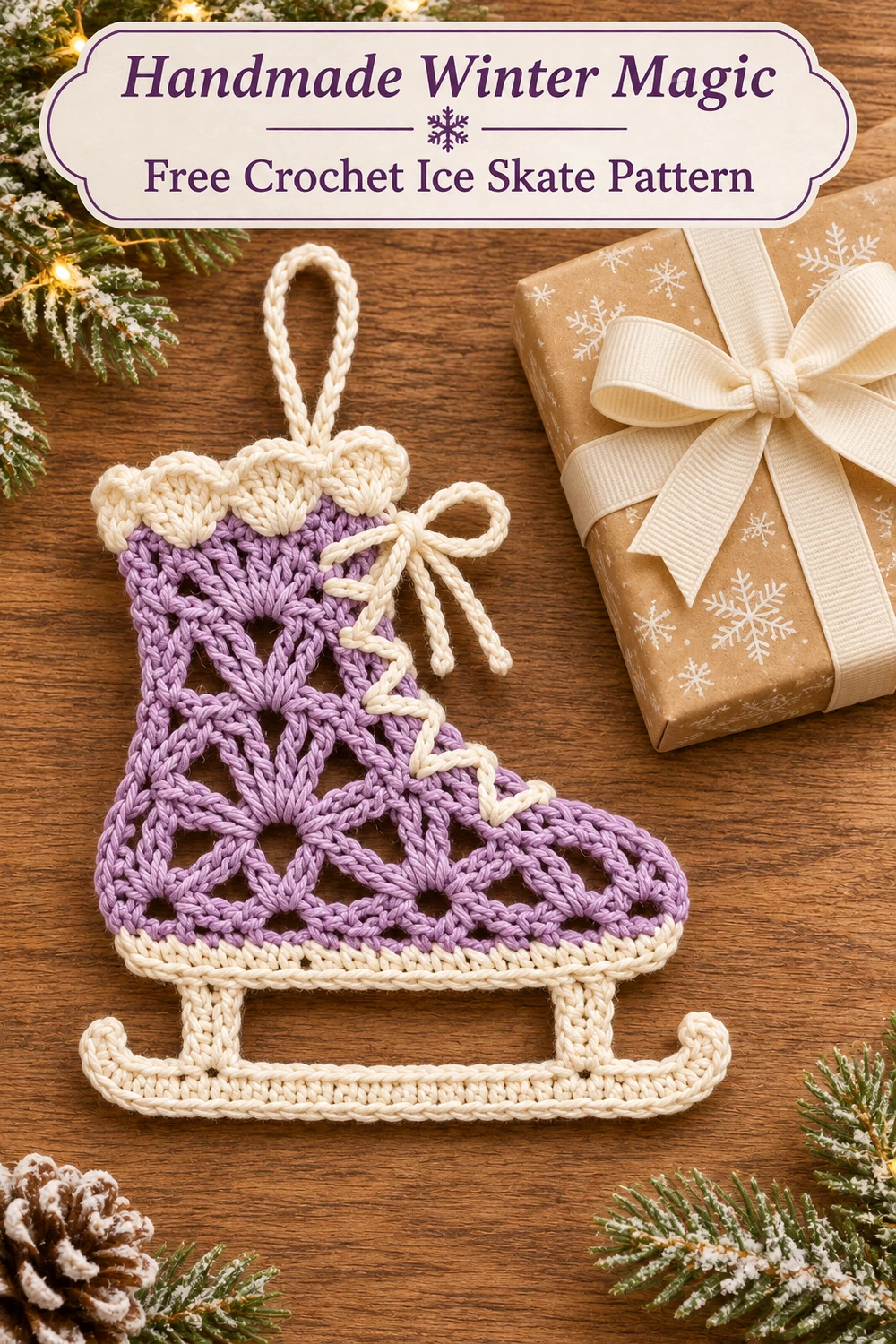
This lavender lace crochet ice skate combines an openwork boot with an ivory scalloped cuff, a small tied bow, and a separate crochet blade. Two short supports leave a clear gap between the sole and blade, giving the flat ornament its recognizable winter silhouette.
The boot is worked flat, beginning at the sole and narrowing to the ankle. Crochet the ivory pieces separately or onto the indicated edges, then sew the supports and blade in place. This is an original interpretation inspired by the reference photograph, not the photographer’s original pattern. The lace has been adapted into a repeatable sequence of chain arches and three-double-crochet groups.
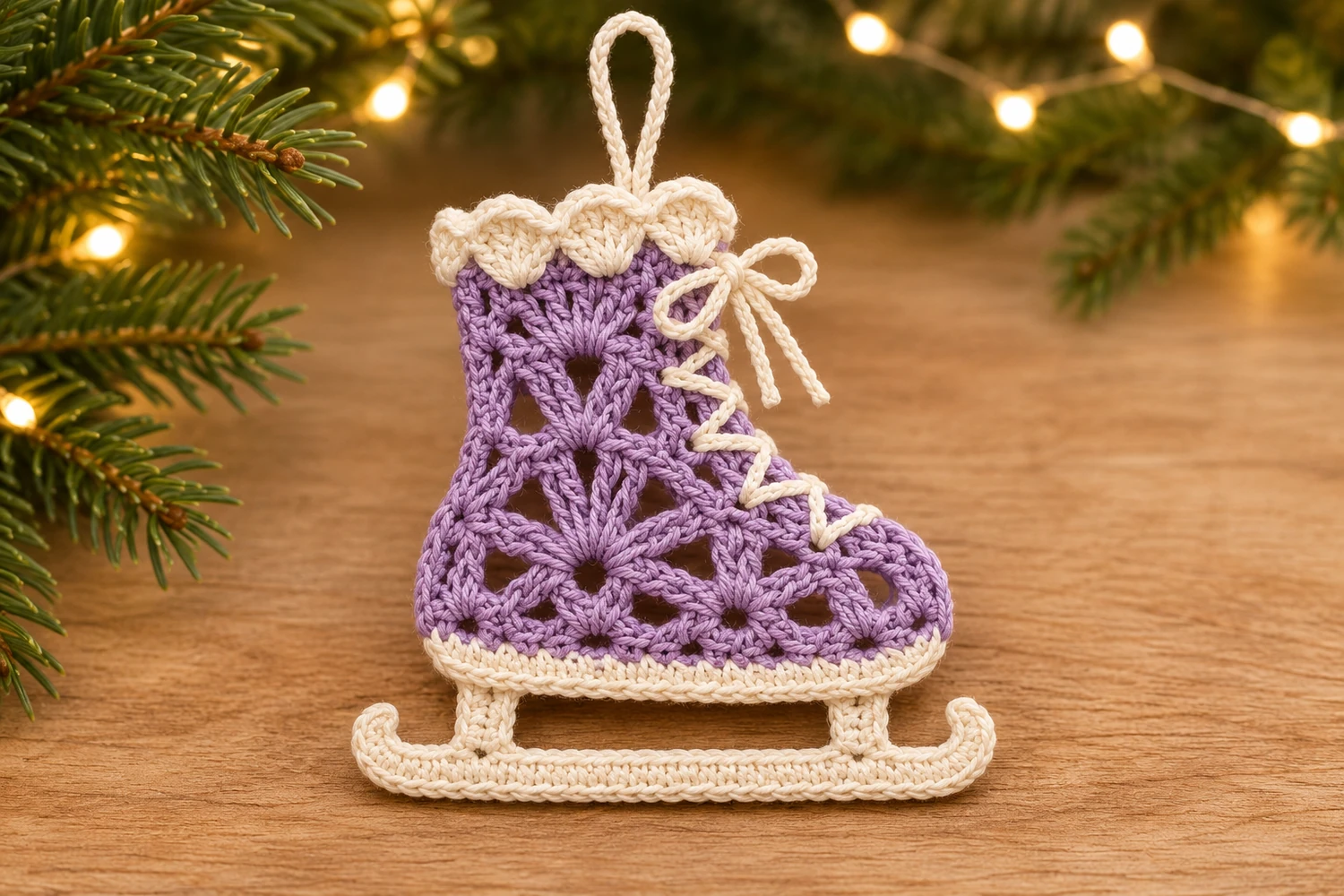
Lavender Lace Crochet Ice Skate Materials
- Smooth fine or sport-weight cotton in lavender and ivory. Allow approximately 15–20 g lavender and 10–15 g ivory as planning amounts, not measured consumption.
- A 2.25 mm crochet hook, adjusted to suit your cotton and tension.
- Scissors, a blunt tapestry needle, removable stitch markers, rustproof pins, and a blocking mat.
- Optional fabric stiffener suitable for the yarn, if a firmer blade is desired.
Difficulty: Intermediate. The crochet uses simple stitches, but the ankle changes width partway through the boot, and the separate blade needs careful alignment. Estimated finished height: approximately 5–6 inches (13–15 cm), excluding the hanger. This is an estimate, not a measured sample. Yarn and tension change the proportions. The counts have been checked on paper; the pattern has not been physically tested.
Before You Start
Use the same weight of cotton for the lavender and ivory. Smooth yarn makes the lace openings and the white lacing easier to see. Keep the sole and blade firm, but do not tighten the chains in the boot so much that the openwork collapses.
The finished boot faces right: the heel is on the left, the ankle rises above the heel, and the toe extends to the right. Because the fabric is turned between rows, its right and wrong faces are similar. After the boot is finished, lay it with the toe pointing right and choose that face as the front before adding the lacing.
The ivory laces are sewn yarn, the little bow is tied, and the blade and supports are crocheted pieces sewn together. There is no metal blade, wire, stuffing, or concealed plastic insert. This is a decorative ornament, not a usable skate or a toy.
US Crochet Terms
- ch: chain
- sl st: slip stitch
- sc: single crochet
- dc: double crochet
- st(s): stitch(es)
- sp(s): space(s)
A group in this pattern means three separate dc worked into one chain arch. These stitches are not a cluster closed together. A mesh arch is ch 3 between two sc anchors. Work around chain spaces unless a stitch top is specifically named.
Beginning ch 1 never counts. The ch 3 at the start of a group row counts as the first dc. Turning chains are not extra edge stitches. General US terminology can be checked against the Craft Yarn Council abbreviation guide.
Counts to Check
| Section | Rows | Completed count |
|---|---|---|
| Boot foundation | 1 | 31 sc |
| Wide foot mesh | 2 and 4 | 11 sc and 10 ch-3 arches |
| Wide foot groups | 3 and 5 | 30 dc in 10 groups; 9 ch-1 spaces |
| Narrow ankle mesh | 6, 8, 10 | 7 sc and 6 ch-3 arches |
| Narrow ankle groups | 7, 9, 11 | 18 dc in 6 groups; 5 ch-1 spaces |
| Cuff foundation | 1 | 24 sc |
| Cuff scallops | 2 | 4 scallops using 6 base stitches each |
| Ivory sole | 1–2 | 31 sc per row |
| Blade | 1–2 | 38 sc per row |
| Blade end tabs | 2 rows at each end | 3 sc per short row |
| Two supports | 1–6 each | 3 sc per row |
Crochet the Lavender Boot
Row 1: Foundation at the Sole
With lavender, ch 32. Sc in the second ch from the hook and in every remaining chain. Turn. (31 sc) Leave the starting tail long enough to weave securely into the heel later.
Row 2: Ten Chain Arches
Ch 1, sc in the first st. Repeat [ch 3, skip 2 sts, sc in the next st] 10 times. Turn. (11 sc and 10 ch-3 arches)
The first sc uses one foundation stitch; the ten repeats use the remaining 30. Mark the first and last sc so the two ends do not disappear into the chain arches.
Row 3: Ten Lace Groups
Sl st into the first ch-3 arch. Ch 3, which counts as the first dc, and work 2 dc into that same arch. Repeat [ch 1, 3 dc in the next ch-3 arch] 9 times. Turn. (30 dc in 10 groups and 9 ch-1 spaces)
Do not add sc between the groups. The nine single-chain gaps separate ten groups; there is no extra ch-1 space at either outer edge.
Row 4: Return to the Mesh
Ch 1, sc in the first dc. Repeat [ch 3, skip the next 2 dc, sc around the next ch-1 gap] 9 times. Ch 3, skip the next 2 dc, and sc in the last dc. Turn. (11 sc and 10 ch-3 arches)
The final anchor goes into the last dc, which is the top of the beginning ch 3 from Row 3. The interior anchors go around chain gaps. This distinction keeps both edges aligned.
Row 5: Complete the Wide Foot
Repeat Row 3 across the ten arches. (30 dc in 10 groups and 9 ch-1 spaces) Fasten off. Spread the piece flat and identify the side you want to become the heel.
Row 6: Start the Ankle over Six Groups
Place the piece so the intended heel is at your left and the toe will extend right. Count the first six groups from the heel. Join lavender in the first dc of the first of those groups. Ch 1, sc in that same dc.
Repeat [ch 3, skip the next 2 dc, sc around the next ch-1 gap] 5 times. Ch 3, skip the next 2 dc, and sc in the last dc of the sixth group. Leave the other four groups unworked for the toe. Turn. (7 sc and 6 ch-3 arches)
The unworked groups are intentional. They create the low front of the boot while the six worked groups rise into the ankle. Do not continue the mesh across the toe.
Rows 7–11: Build the Ankle
Row 7: Sl st into the first arch. Ch 3, 2 dc in that arch; repeat [ch 1, 3 dc in the next arch] 5 times. Turn. (18 dc, 6 groups, and 5 ch-1 gaps)
Row 8: Ch 1, sc in the first dc. Repeat [ch 3, skip 2 dc, sc around the next ch-1 gap] 5 times. Ch 3, skip 2 dc, sc in the last dc. Turn. (7 sc and 6 arches)
Row 9: Repeat Row 7. (18 dc and 5 ch-1 gaps)
Row 10: Repeat Row 8. (7 sc and 6 arches)
Row 11: Repeat Row 7. (18 dc and 5 ch-1 gaps) Fasten off and weave in the lavender ends.
Ivory Scalloped Cuff
Join ivory at one end of the upper edge of Row 11. Cuff Row 1: ch 1, sc in each dc and work 1 sc into each ch-1 gap. Add one extra sc into the very last dc, so that stitch receives 2 sc in total. Turn. (24 sc) The underlying edge has 18 dc and five gaps: 18 + 5 + 1 extra = 24.
Cuff Row 2: ch 1. Repeat [sl st in the next st, skip 1 st, 5 dc in the next st, skip 1 st, sl st in each of the next 2 sts] 4 times. Fasten off. (4 scallops) Each repeat uses six base stitches, so all 24 sc are used.
Keep the slip stitches relaxed. Let the four fans sit above the lavender ankle without pulling its two sides inward.
Add the Ivory Sole
With the boot toe pointing right, join ivory at the heel end of the unused underside of the original foundation chain. Sole Row 1: ch 1, work 1 sc into each of the 31 unused foundation positions. Turn. (31 sc)
Sole Row 2: ch 1, sc in each st. Fasten off with a sewing tail. (31 sc) The sole follows the full width of the foot. Do not work up the ankle edges in this step.
At the toe, use the tail to secure the last sole stitch neatly to the adjacent lavender edge. Do not gather the whole toe into a ball. Its rounded appearance comes from shaping the outer lace groups during blocking.
Crochet the Separate Blade
With ivory, ch 39. Blade Row 1: sc in the second ch from the hook and in each remaining ch. Turn. (38 sc)
Blade Row 2: ch 1, sc in each st. Turn. (38 sc)
First raised end: ch 1, sc in the first 3 sts only. Turn. Ch 1, sc in those 3 sts. Fasten off. (3 sc in each of 2 short rows)
Second raised end: join ivory at the opposite end of the long blade edge. Ch 1, sc across the last 3 stitches of Blade Row 2. Turn, ch 1, sc in those 3 sts. Fasten off. (3 sc in each of 2 short rows)
The two short-row tabs sit at opposite ends of the same long edge. During blocking, ease them upward and slightly outward to suggest the curled ends of a skate blade. They do not form closed loops. Keep the middle strip straight and the two ends similar in height.
Make Two Blade Supports
For each support, ch 4 with ivory. Row 1: sc in the second ch from the hook and the next 2 chains. Turn. (3 sc)
Rows 2–6: ch 1, sc in each of the 3 sts. Turn after every row. Fasten off with a long sewing tail. Make a second matching strip. (3 sc in every row)
These strips are separate crochet pieces. Their narrow ends attach to the sole and blade; the length of six rows sets the open gap between them. Keep both strips unstuffed and untwisted.
Block and Sew the Skate
Dampen the cotton according to its label. Pin the boot with its heel and ankle upright, then ease the four unworked toe groups into a shallow curve. Keep the sole almost horizontal. Do not stretch the ankle into a narrow tube. Dry the blade and supports separately so their shapes stay easy to compare.
Place the blade below the sole with a small amount extending beyond both heel and toe. Position one support near the heel, approximately five sole stitches inward from the left edge. Place the other beneath the front of the foot, approximately five sole stitches inward from the right edge.
Sew the upper short ends of the supports to the back of the sole with small ivory stitches. Pin the blade in place before attaching the lower ends. Sew both lower support ends to the back of the straight blade strip, keeping the gap even. The raised blade ends remain free; do not sew them directly to the toe or heel.
Check the ornament from the front. The blade should extend horizontally, and the supports should sit behind it rather than across its face. Secure all tails and bury them through matching stitches. If stiffener is used, follow its instructions and test it on a swatch first; no particular product has been tested for this pattern.
Sew the Laces and Tie the Bow
Thread a length of ivory yarn onto the needle. On the front edge of the ankle, identify two parallel lines of firm stitches, one on each side of the area you want to lace. Begin near the instep, below the cuff, and sew an X between those two lines.
Move upward and repeat, making three or four evenly spaced crosses. Pass through solid crochet strands, not empty lace openings. The yarn should rest on the surface without pulling the ankle inward. The lacing is decorative sewing, not a new crochet round.
Bring the two yarn ends out near the upper side of the boot and tie a small bow. Secure the bow’s center with one hidden matching sewing stitch if needed, then trim the two ends evenly. Keep the bow modest so the cuff scallops remain visible.
Add the Hanging Loop
Join ivory to a strong stitch at the top of the ankle, slightly toward the heel so the skate hangs level. Ch 28 and sl st back into the same attachment area. Fasten off and use the tail to reinforce the base with several small sewing stitches.
Hold the loop gently and check the balance before securing the last tail. If the toe dips sharply, move the attachment slightly toward the toe. Do not suspend the ornament from a single open chain arch or from the tied bow.
Troubleshooting and Care
The Ankle Is Too Wide
Check that Row 6 used six groups and left four toe groups unworked. Continuing across all ten groups makes a rectangle instead of a boot. Count six arches in every ankle mesh row and six groups in every ankle group row.
The Lace Edge Looks Uneven
On a mesh row, the interior sc go around ch-1 gaps, but the final sc goes into the last dc. On a group row, the beginning ch 3 is the first dc. Missing that stitch on the return row shortens one edge.
The Blade Twists or Sags
Check that the two supports have the same row count and are attached without a half twist. Block the blade flat and keep the sewing stitches short. The strip is decorative cotton, so a firmer finish may require suitable stiffener; do not insert sharp wire to make it rigid.
Store the dry ornament flat so the blade does not fold under the boot. Spot-clean gently, reshape while damp, and let it dry completely before hanging. Keep the long hanging loop and small tied components away from young children.
More Winter Crochet Ornaments
Pair the soft lavender palette with the Lavender Lace Crochet Star. The Picot Fan Crochet Snowflake is another openwork decoration, while the Lace Medallion Christmas Square adds a framed motif to a handmade tree.