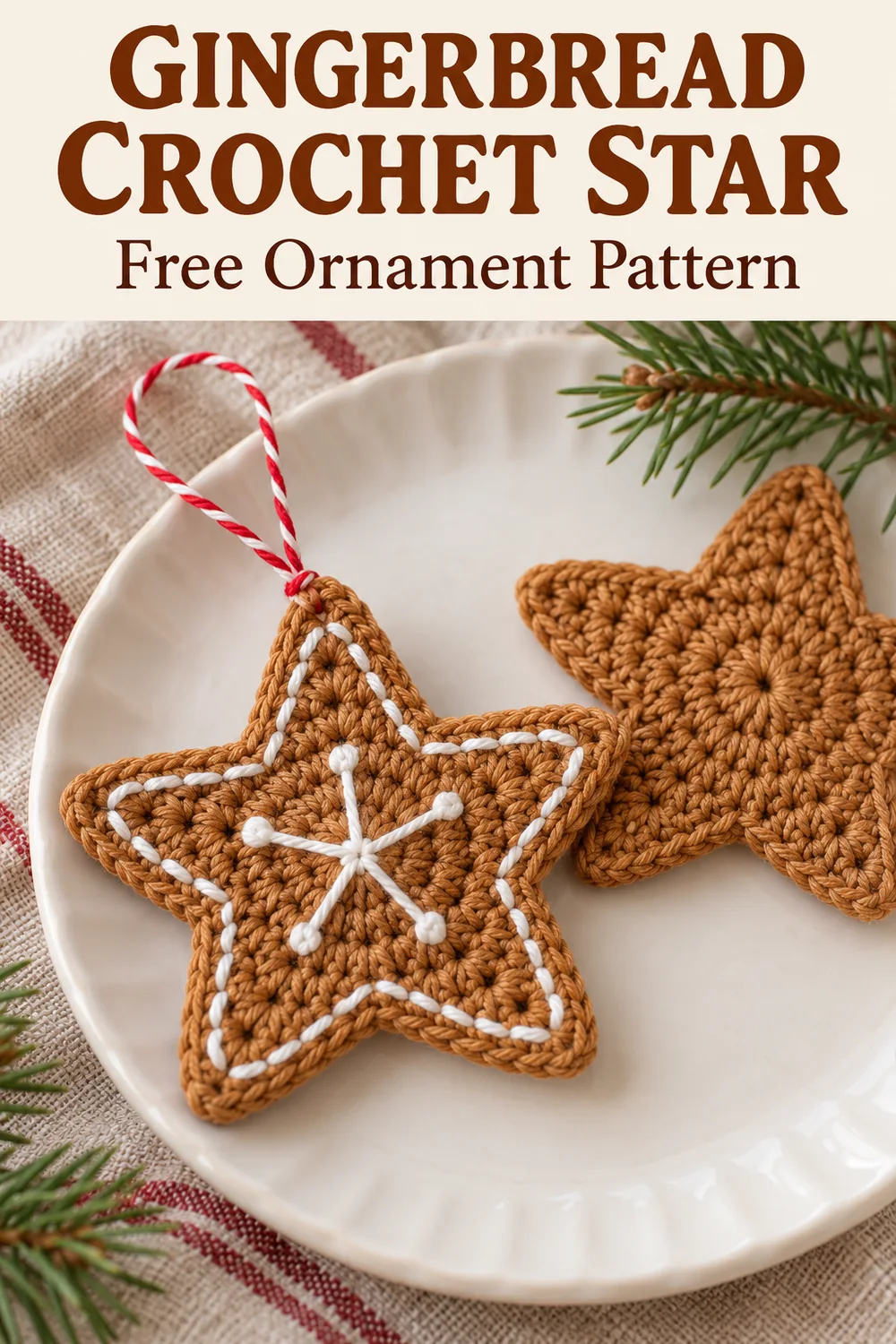
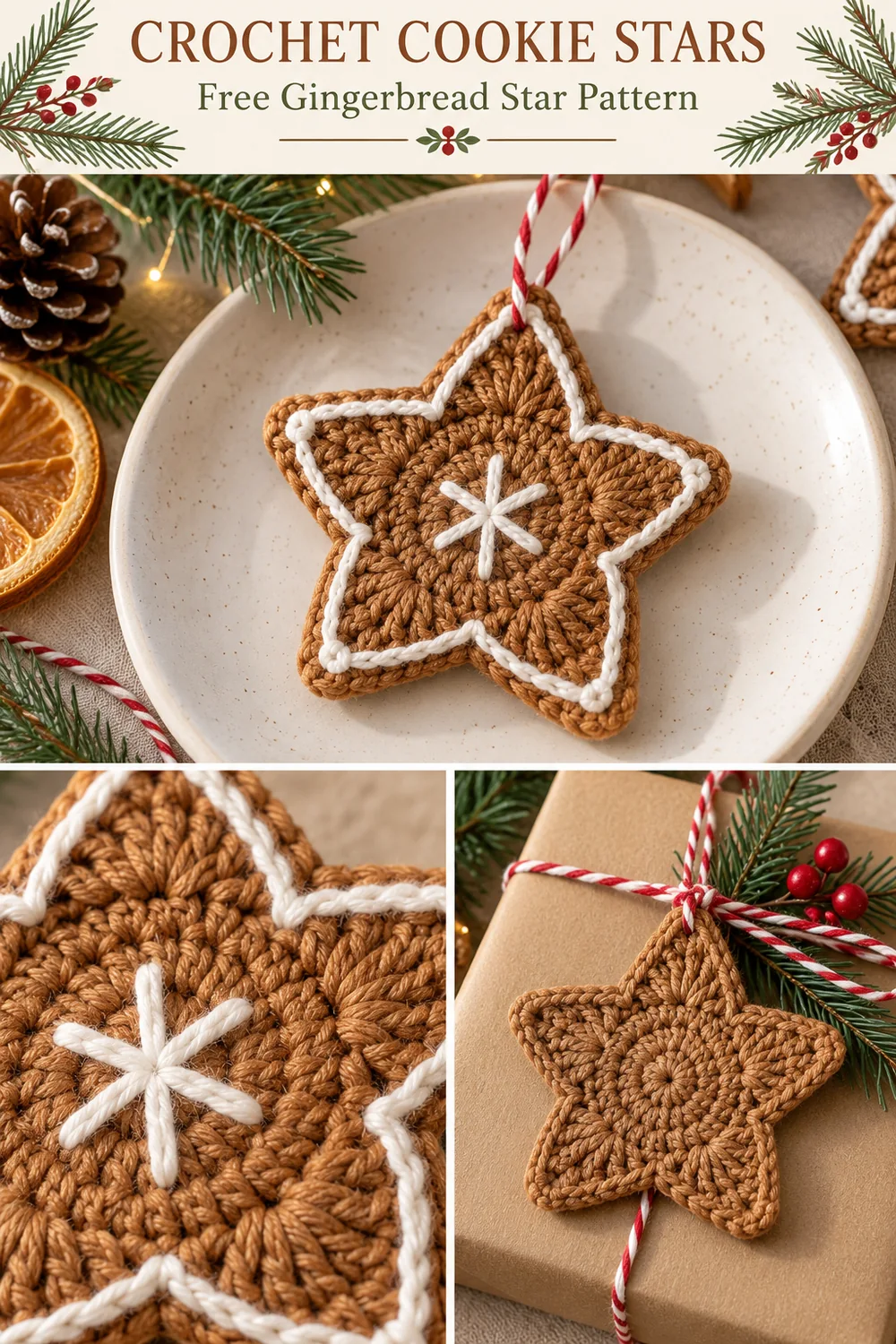
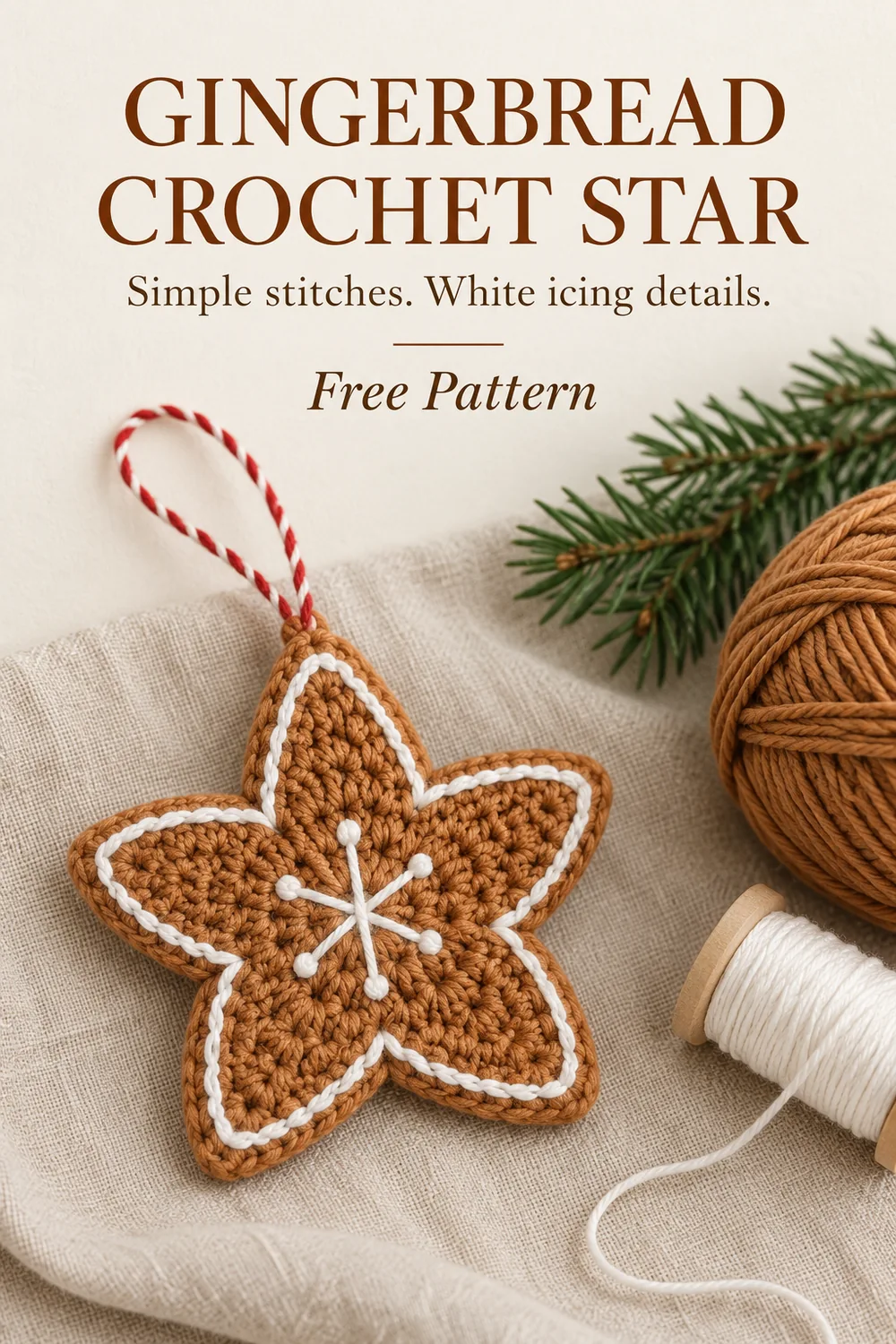
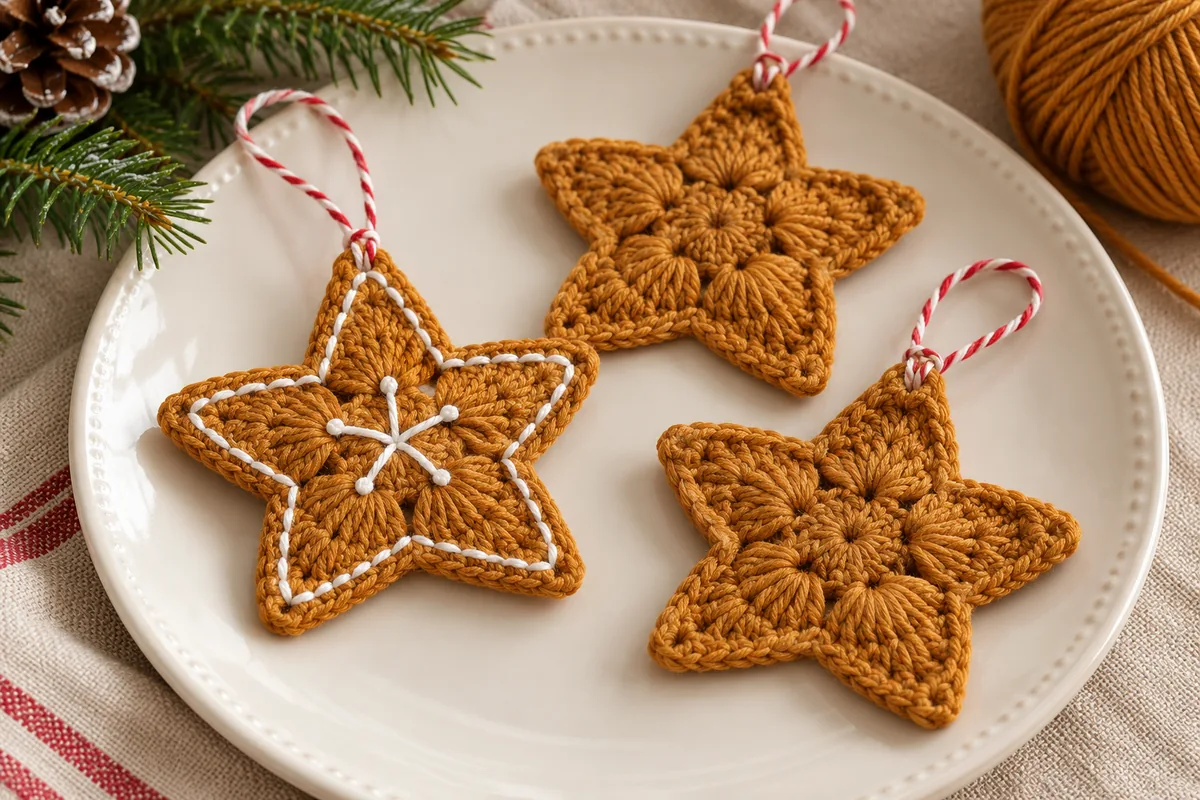
A gingerbread crochet star gets its cookie-like character from caramel yarn and a fine white embroidered outline. The crochet stays flat, while the white details sit slightly inside the edge like piped icing.
This original pattern takes inspiration from the reference ornament without claiming to reproduce its exact stitches. A small double-crochet center supports five fan-shaped points, each worked across three base stitches. The white outline and center motif are added afterward with a needle.
Make a plain star first and check all five repeats before adding the embroidery. For a more open ornament, the floral crochet snowflake uses a different construction. Here, a compact two-round motif keeps the focus on the caramel color and white icing details.
Jump to the free written pattern
Materials for a gingerbread crochet star
- Smooth sport or DK cotton yarn in caramel, cinnamon or golden brown.
- White yarn of the same weight or slightly finer for the embroidered icing.
- A hook suited to your yarn. A 3 mm hook is a starting choice for DK; adjust to obtain defined stitches without a stiff fabric.
- A blunt yarn needle, scissors, five removable stitch markers and a blocking surface with rustproof pins.
- Red-and-white cord or strong yarn for the optional hanging loop.
No filling is needed. This is a small decorative motif for a confident beginner familiar with tall stitches and simple embroidery. Finished size, gauge and yarn use have not been established from a physical sample. The design has not been physically tested; the written stitch arithmetic has been checked. Photos illustrate the intended styling, and the diagrams are explanatory guides rather than a tested exact chart.
US crochet terms and preparation
ch = chain; sc = single crochet; hdc = half double crochet; dc = double crochet; tr = treble crochet; sl st = slip stitch; st/sts = stitch/stitches; ch-2 sp = chain-two space. The Craft Yarn Council crochet abbreviation guide lists the standard US names.
Work both rounds with the right side facing you; do not turn. Beginning chains and joining slip stitches do not count. Start each round in the same stitch as the join unless instructed otherwise. A parenthesized group is worked entirely into one base stitch.
How to work the taller stitches
For hdc, yarn over once, insert the hook and pull up a loop, then yarn over and pull through all three loops. For dc, yarn over once, insert and pull up a loop, then pull through two loops twice. For tr, yarn over twice before inserting the hook, pull up a loop, then yarn over and pull through two loops three times.
Keep the treble stitches close in height to one another. They sit immediately beside the chain-two tip, so an unusually loose treble on one side can make that point lean. Mark each group of three center stitches if counting the repeats is difficult.
Gingerbread crochet star: free written pattern
Round 1: the center
With caramel yarn, make a magic ring. Ch 2, work 15 dc into the ring, then sl st into the first dc. The starting ch 2 does not count. Tighten the ring gradually and secure its tail through the backs of several stitches.
Count: 15 dc. Before proceeding, identify the first real dc and exclude the joining slip stitch from your count. Divide the center into five consecutive groups of three stitches. Place a marker in the first stitch of each group.
Round 2: five points
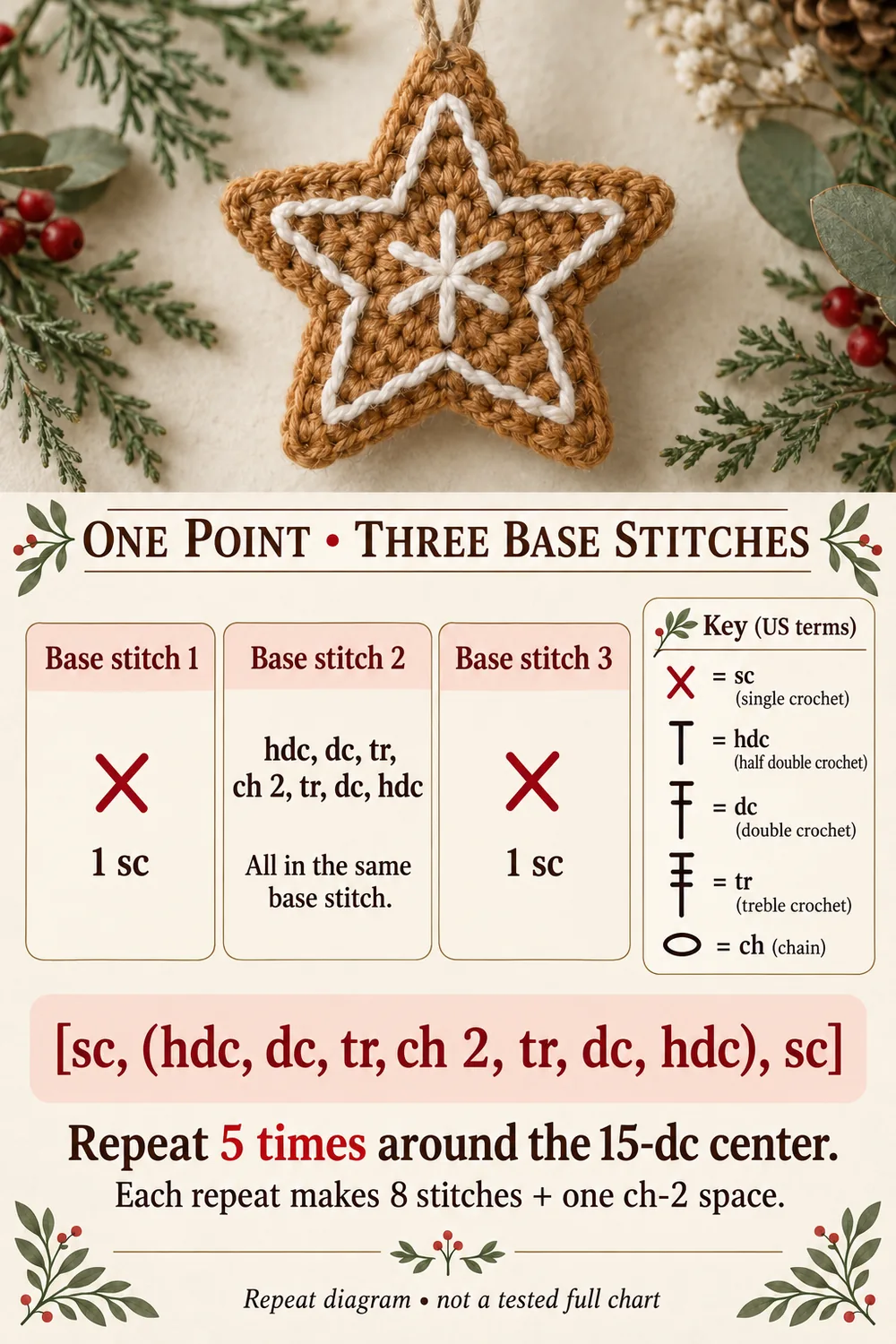
Ch 1. Beginning in the first dc, repeat this sequence five times:
- Sc in the next center stitch.
- In the next center stitch, work (hdc, dc, tr, ch 2, tr, dc, hdc), all into that one stitch.
- Sc in the next center stitch.
After the fifth repeat, sl st into the first sc of Round 2. Fasten off and weave the tail into the back without tightening the final valley.
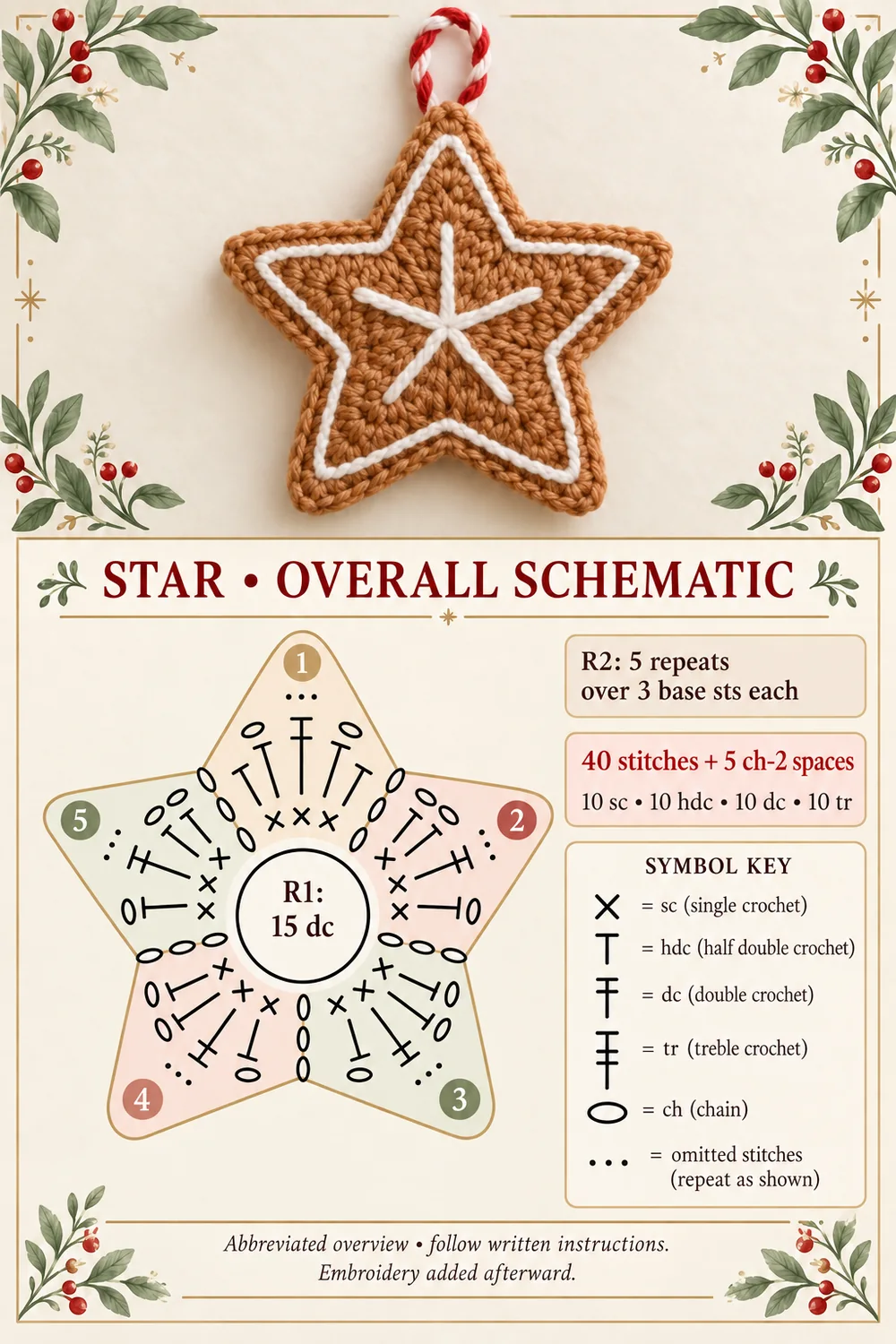
Round 2 count: 40 crochet stitches plus 5 ch-2 spaces. The stitches are 10 sc, 10 hdc, 10 dc and 10 tr. The ten individual chains making the five tip spaces are additional to those 40 stitches. Each repeat consumes exactly three center stitches and produces eight crochet stitches plus one chain-two space.
Check the star before decorating
There should be one chain-two space at each of the five tips. Between neighboring fans, two sc sit next to each other to form the valley. A missing sc moves the following fan onto the wrong base stitch; correct it before adding embroidery.
| Section | Base stitches used | Output |
|---|---|---|
| Round 1 | Magic ring | 15 dc |
| One Round 2 repeat | 3 dc | 2 sc + 2 hdc + 2 dc + 2 tr + one ch-2 space |
| All five repeats | 15 dc | 40 stitches + five ch-2 spaces |
| White embroidery | Surface of finished motif | No additional crochet round |
Shape the plain star first
Lay the unembroidered motif on a flat surface. If the yarn label allows wet blocking, dampen it gently, press out excess water in a towel and pin the five chain-two tips evenly. Ease the valleys inward without pulling the center open. Allow it to dry completely.
Blocking should refine a sound shape, not compensate for missing stitches. If a point is visibly larger, check that its fan contains one hdc, one dc and one tr on each side of the chain-two space. If the whole piece forms a deep cup or a strong ruffle, recount the center and repeats before adjusting hook size on a new motif.
Embroider the white icing outline
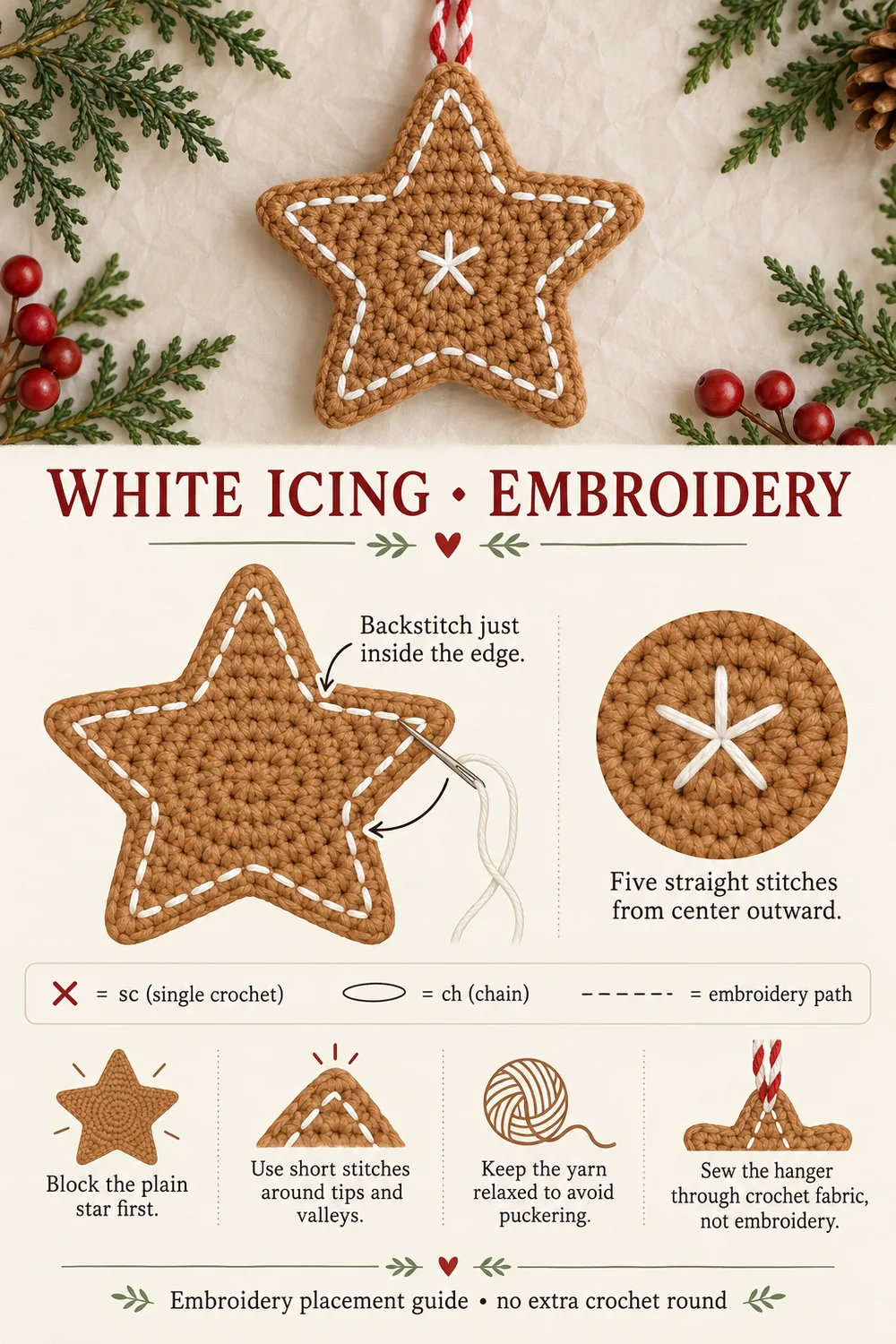
Thread a blunt needle with white yarn. For a delicate line, use yarn slightly finer than the caramel yarn. Keep the front of the star facing you and plan a path just inside the outer edge, leaving a visible caramel border around it. Follow the shape of the five points and valleys rather than passing straight across them.
Secure the yarn on the back. Bring the needle up at the start of the path. To backstitch, insert it a short distance behind that starting point, then bring it up the same short distance ahead. For the next stitch, insert into the previous starting point and bring it up farther along the path. Continue so the stitches meet end to end on the front.
Use shorter stitches at tips and valleys, where the direction changes sharply. Pass through the crochet fabric rather than stretching white yarn across an open tip space. Every few stitches, lay the ornament flat and relax the embroidery if it begins to pucker. There is no fixed embroidery stitch total because stitch length and motif size vary.
When the line returns to its starting point, join the last stitch neatly to the first. Secure the white yarn through the backs of several caramel stitches, taking care not to show white strands outside the outline.
Add the center asterisk
Bring white yarn up near the center and make one straight stitch toward the base of a point, stopping well inside the icing outline. Return through the back to the center and repeat toward the other four points. Five straight stitches make a five-spoke motif. Keep the central entries close together without repeatedly piercing the same yarn strand.
A six-spoke asterisk is an optional decorative variation seen in some styling images: divide the center into six directions instead. It does not change the crochet count. Keep the white stitches short enough that they rest on the surface without snagging or pulling the star inward.
Attach a hanging loop
Fold a length of red-and-white cord into a loop and sew its ends securely through several caramel stitches beside one tip. Catch the crochet fabric on both sides of the chain-two space. Avoid suspending the ornament from the white embroidery alone.
Hide the cord ends on the back and check the hanging position. For a gift tie, pass a separate cord through the same reinforced area so removing the package tie does not pull out the icing stitches. One plain star can also be used as an applique after its ends are secured.
Troubleshooting your gingerbread crochet star
I have only four points
Count the center: Round 1 needs 15 real dc. Each point uses three of them. If you worked five base stitches into one fan instead of putting the entire fan in a single stitch, you will run out of center stitches early.
The final repeat does not fit
Check whether you counted the initial ch 2 or joining slip stitch as a dc. Also check for a skipped valley sc. The five repeats must consume all 15 center stitches once, with no shared or unused bases.
One tip is blunt or twisted
Check for both treble stitches and the chain-two space between them. Untwist the space gently, then compare the tension of the two tr stitches. Do not pull the embroidery tightly around the tip to sharpen it.
The white line disappears into the crochet
Move the path slightly farther inside the edge and take smaller backstitches over stable parts of the fabric. A very fine thread may need to be doubled, but avoid a thick white line that overwhelms the caramel stitches.
The star curls after embroidery
Loosen or remove the affected white stitches. The plain motif should already be shaped before decoration. Rework that section with relaxed tension and check it flat after each short run.
Display and care
Mix plain and iced stars on a garland, or repeat one embroidery treatment for a coordinated set. Keep any added knots small so the back remains flat. For a tree display, pair them with the spiral crochet Christmas tree; the crochet pinecone ornament adds another warm woodland texture.
Clean according to the yarn and cord labels. Store flat with the hanging loop laid above the star, avoiding folds across the points. These are textile decorations rather than food; keep display pieces separate from actual cookies and serving dishes in use.
Gingerbread crochet star: pins and diagram guides
The first three images show styling options. The final three cover the overall five-sector structure, one three-base-stitch repeat and the icing embroidery. The overview deliberately abbreviates stitches; use the written pattern and count table for the full sequence. Image texture and decorative details illustrate the idea rather than documenting a physically tested sample.