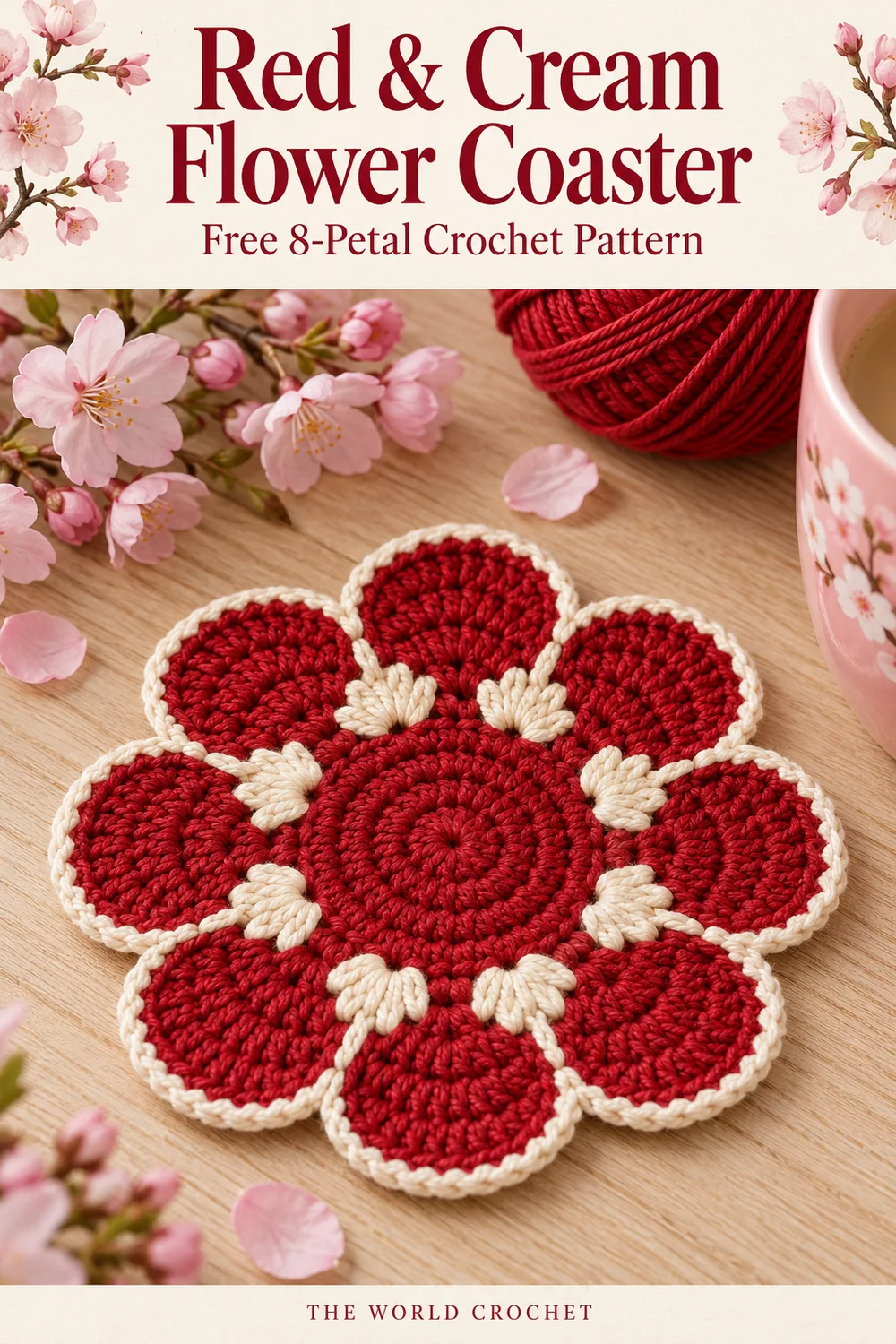
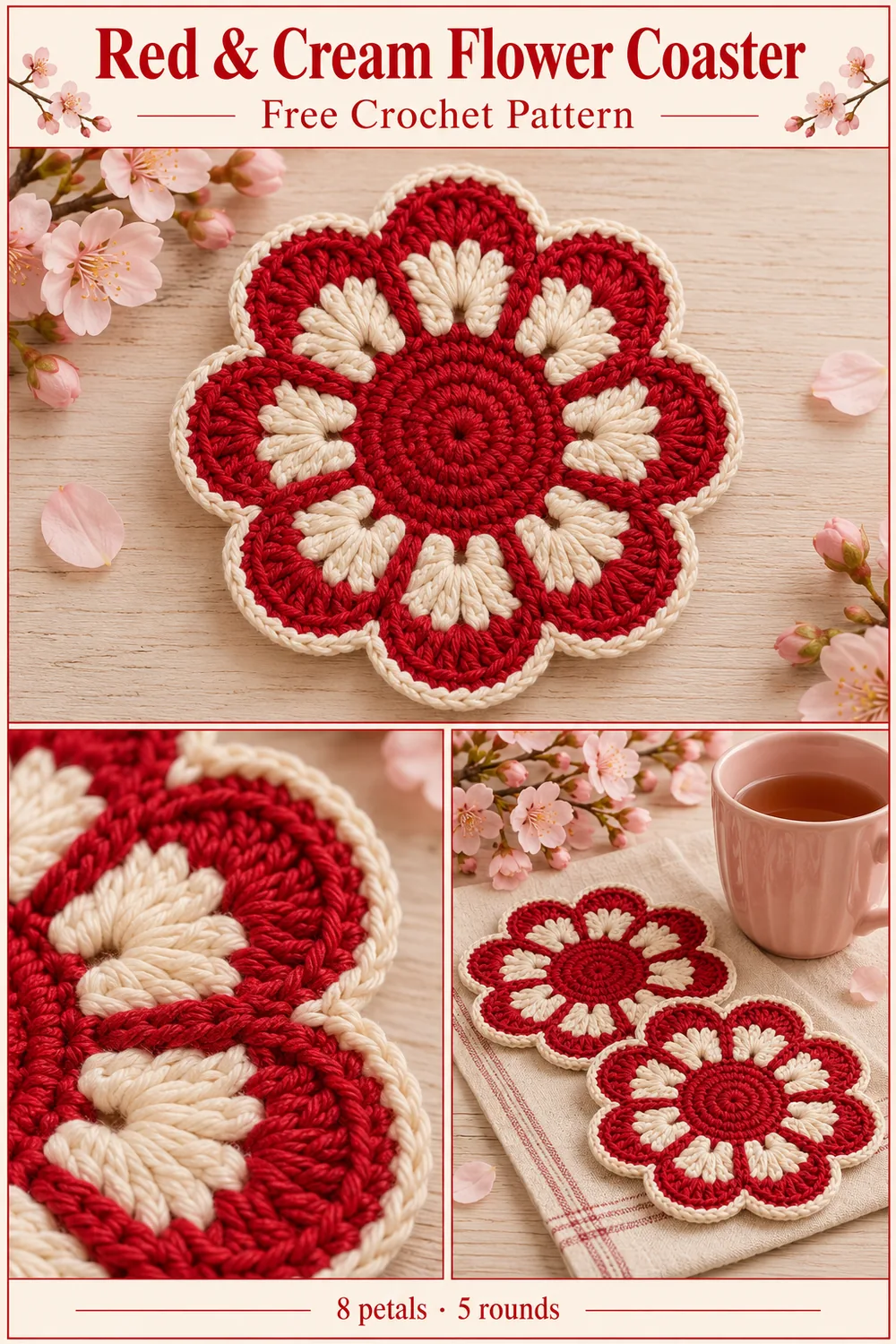
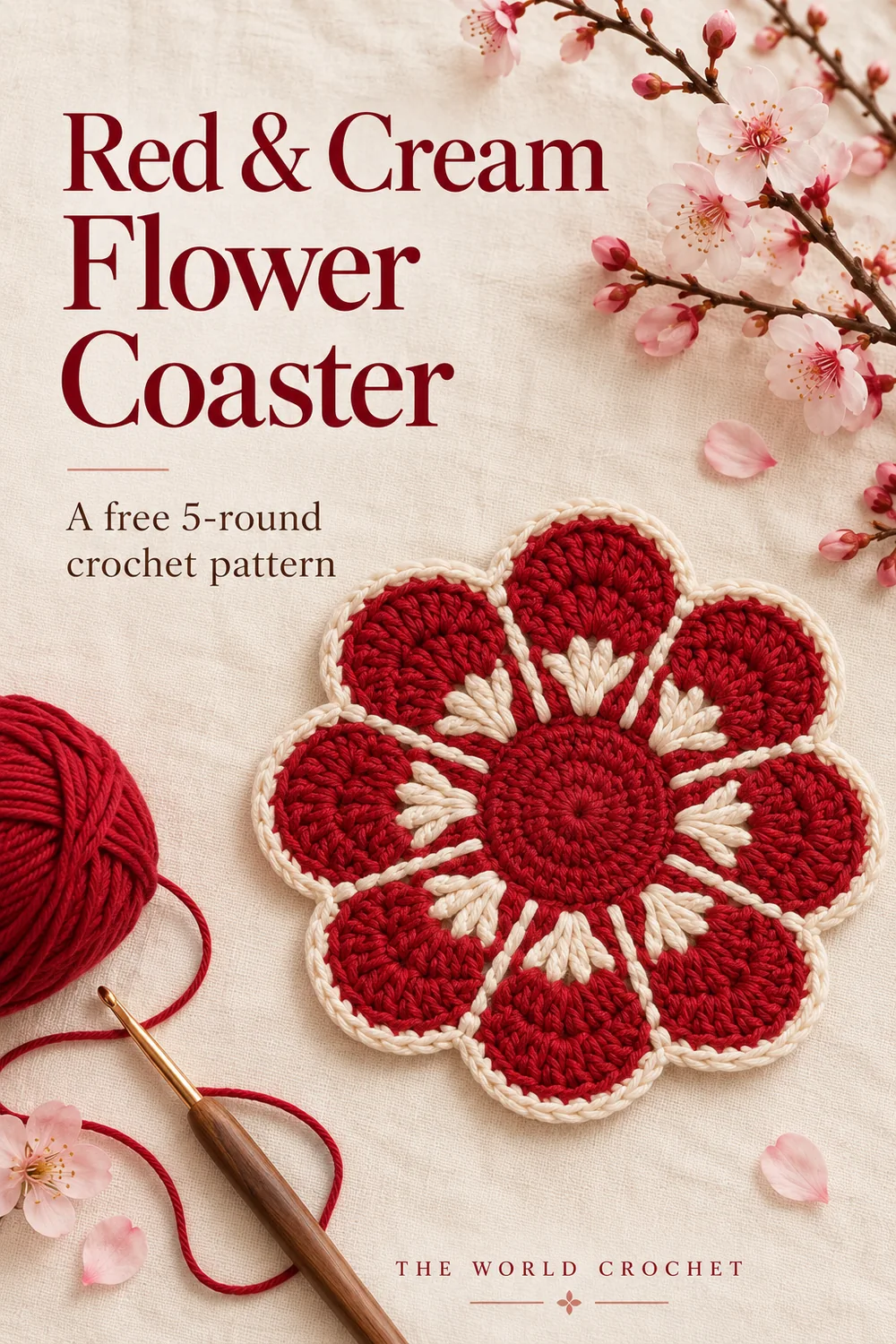
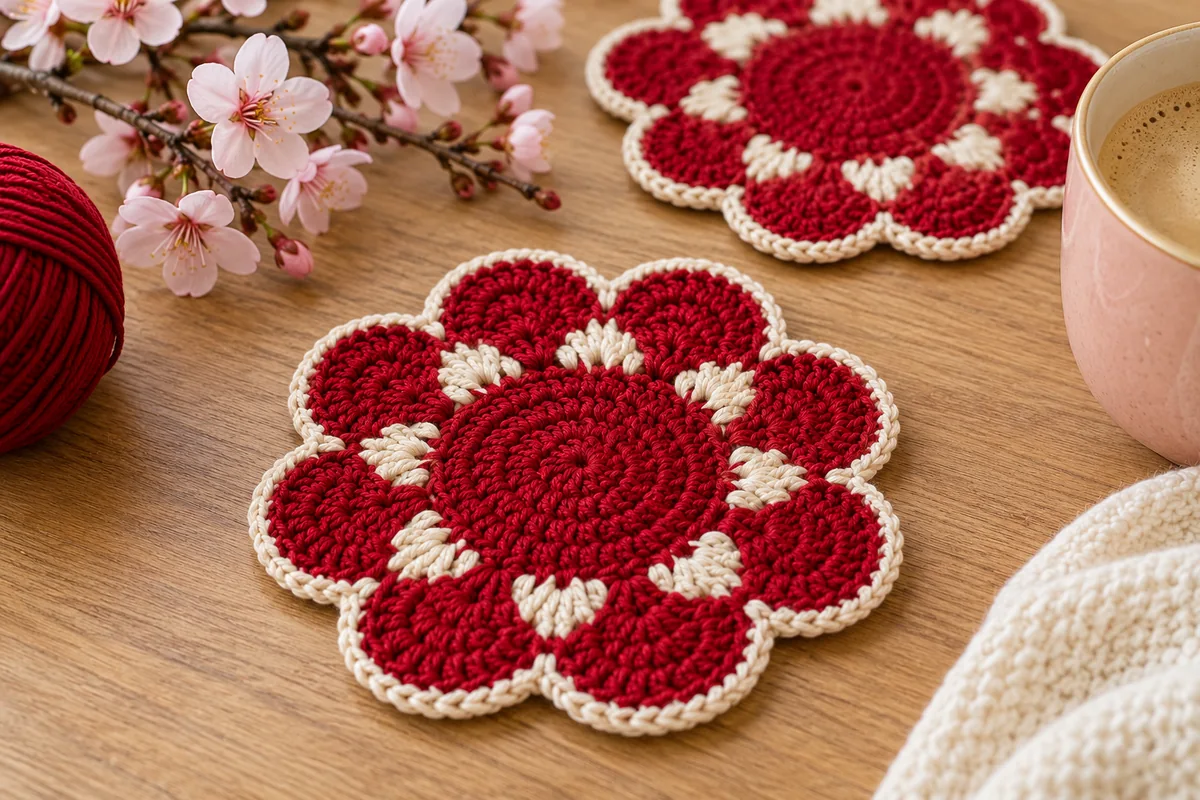
A red and cream flower coaster brings a bold floral outline to a small table setting. This version pairs a red circular center with eight rounded red petals, small cream fan groups and a fine cream edge that follows the dips between the petals.
The free pattern below is an original interpretation inspired by the reference image, not the exact recipe behind the photograph. Its stitch counts have been checked for internal consistency, but the design has not been physically crocheted or tested. Make one motif first and check its shape and fit with your own yarn and cup.
Five joined rounds build the flower from the center outward. The cream groups create eight chain spaces, each of which receives one red shell. A final round of single crochet outlines the shells while slip stitches keep the valleys low and distinct.
Choose cotton for your red and cream flower coaster
Use smooth cotton in two colors of the same weight. A firmly spun yarn makes it easier to see the cream fan groups and to identify each red double crochet when adding the border. Fuzzy yarn can hide the valleys where the edging changes from single crochet to slip stitch.
- DK-weight cotton in cherry red and warm cream.
- A 3 mm crochet hook as a starting point, adjusted to your yarn and tension.
- A blunt yarn needle, scissors and a removable stitch marker.
- A flat drying surface and rustproof pins if your yarn allows damp blocking.
No measured gauge, finished diameter or yarn consumption is supplied for this untested interpretation. Crochet the first motif before planning a set. Measure its red center and compare it with the base of the cup or glass you intend to use; the outer petals are decorative and should not be relied on to level an unstable cup.
This project suits a confident beginner who can work double crochet, follow a skipped-stitch repeat and join rounds. The construction uses ordinary stitches rather than clusters: every three-dc cream group has three separate stitch tops, and every red shell has nine separate stitch tops.
US stitch terms and the eight-repeat rhythm
Instructions use US terminology. For the standard names, see the Craft Yarn Council crochet abbreviations guide.
- MR: magic ring
- ch: chain
- sl st: slip stitch
- sc: single crochet
- dc: double crochet
- st/sts: stitch/stitches
- sp: space
- Shell: 9 dc worked into one indicated ch-3 space.
Double crochet: yarn over, insert the hook into the indicated stitch or space, yarn over and draw up a loop. Yarn over and pull through two loops, then yarn over and pull through the remaining two loops. Each dc has its own finished top; do not close several dc together as a cluster.
Single crochet: insert the hook, yarn over and draw up a loop, yarn over and pull through both loops. Slip stitch: insert the hook, yarn over and pull through the fabric and the loop on your hook in one movement. Keep the slip stitches relaxed enough that they do not draw the flower inward.
Work in joined rounds without turning. In Rounds 1–3, the beginning ch 3 counts as one dc. In Rounds 4–5, the beginning ch 1 does not count. Joining slip stitches and the slip stitches used to attach a new color are excluded from the round totals. The eight valley slip stitches in Round 5 are part of that round’s edging and are counted separately.
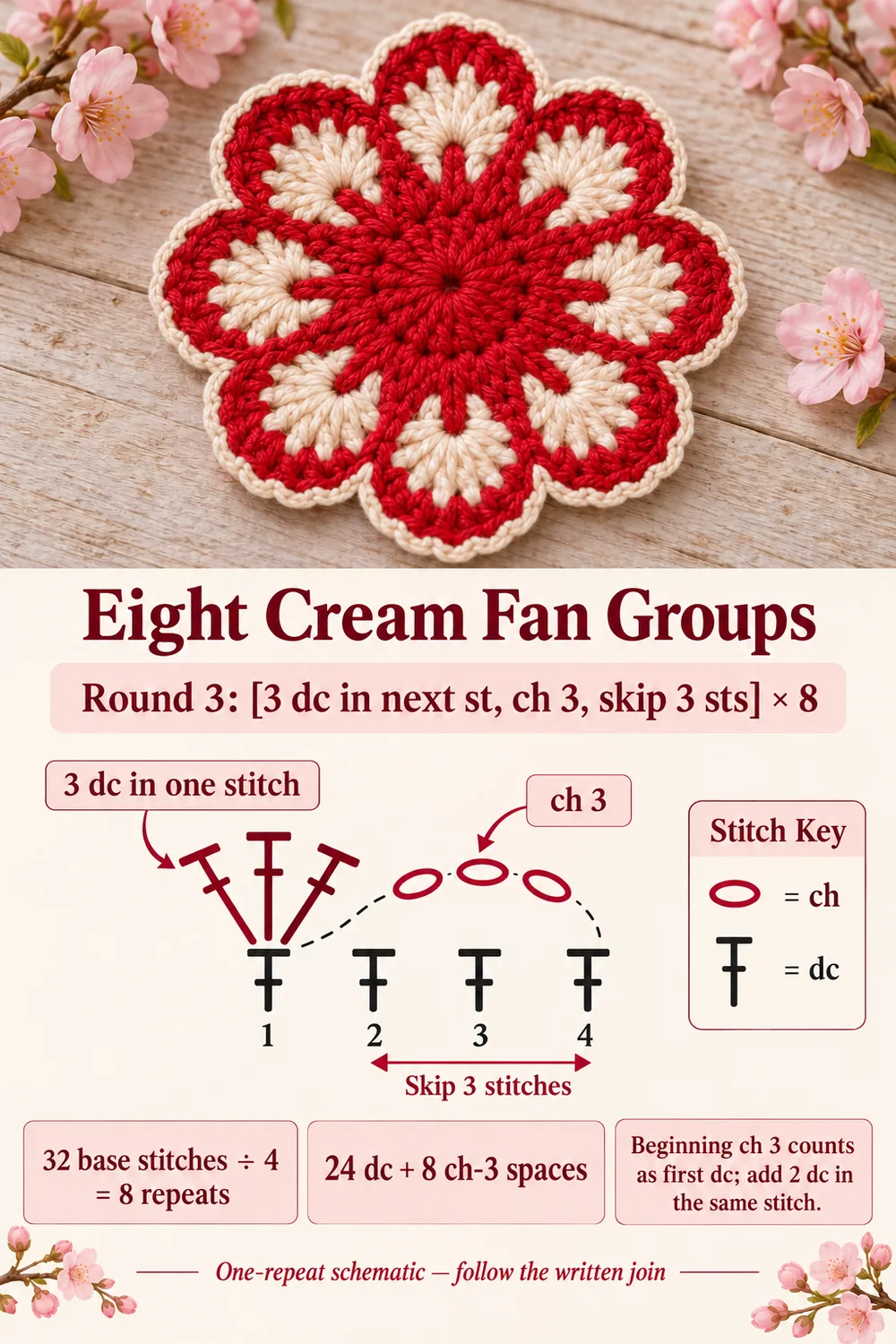
The foundation grows from 16 dc to 32 dc. Round 3 then uses four foundation stitches for each repeat: one stitch holding three dc and three skipped stitches beneath a chain arch. Thirty-two divided by four gives eight repeats, so the flower has eight spaces for eight red petals.
Red and cream flower coaster: five-round pattern
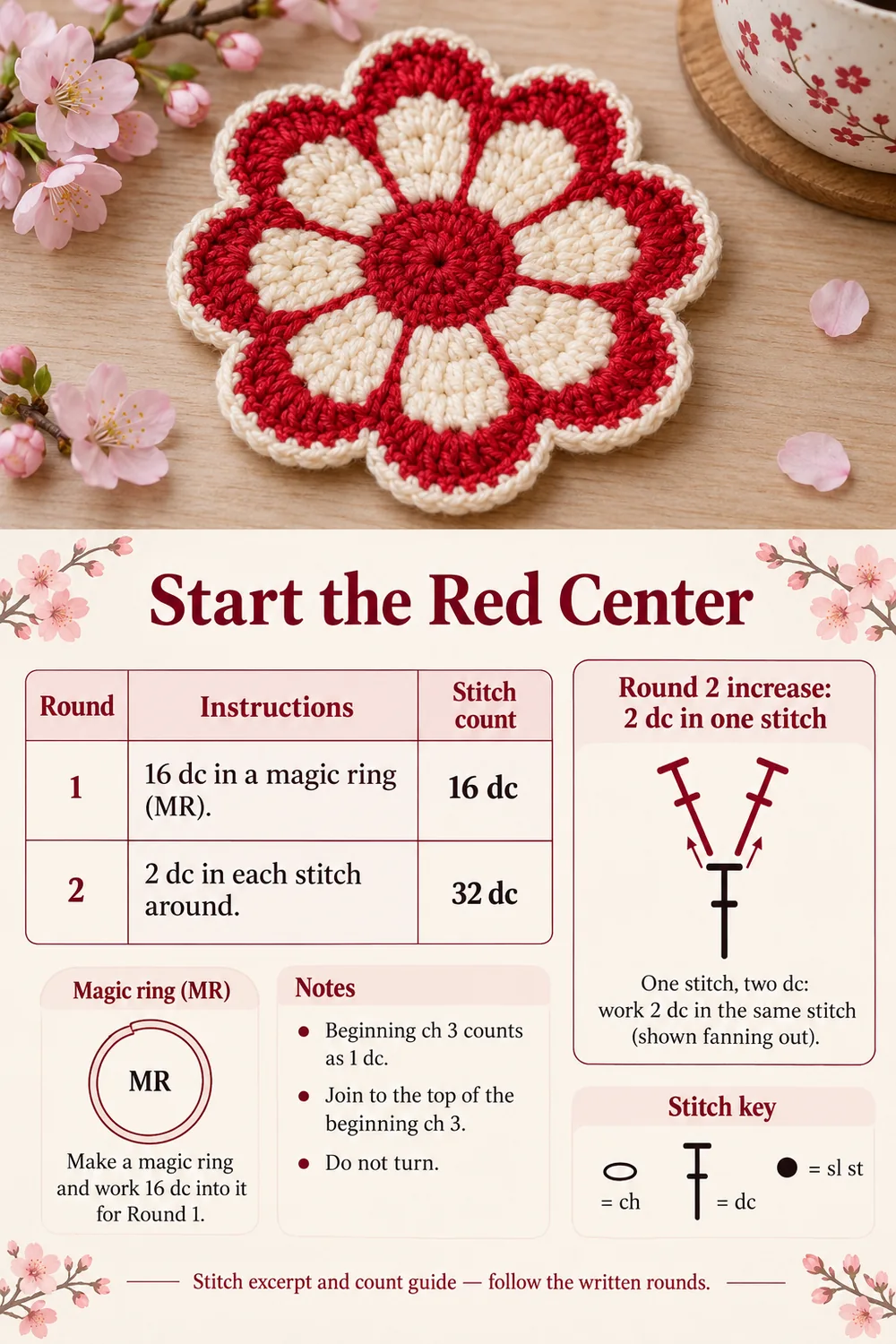
Round 1: start the red disk
With red, make a magic ring. Ch 3 to count as the first dc, then work 15 dc into the ring. Pull the ring closed gently and join with a sl st to the third chain of the beginning ch 3. Count: 16 dc. Keep red attached.
Mark the top of the beginning ch 3 if you tend to lose it. It is the sixteenth counted dc when checking the round, even though you made those chains first. The joining slip stitch is not an extra stitch to work into.
Round 2: double the center count
Ch 3 to count as the first dc, then work 1 dc into the same stitch at the base of the chain. Work 2 dc into each of the remaining 15 stitches. Join to the top of the beginning ch 3. Count: 32 dc. Fasten off red.
The first increase consists of the beginning ch 3 plus one dc. Do not add two more dc at that starting stitch, or you will finish with 33 stitches. Lay the red center down and check that it is reasonably flat before adding the cream round.
Round 3: make eight cream fan groups
Join cream with a sl st in any dc of Round 2. Ch 3 to count as the first dc, then work 2 dc into that same stitch. Ch 3 and skip the next 3 stitches. Repeat [3 dc in the next stitch, ch 3, skip the next 3 stitches] seven more times. Join to the top of the beginning ch 3. Fasten off cream.
Count: 24 dc arranged in eight groups of three, plus 8 ch-3 spaces. The final three skipped stitches are the last unused stitches immediately before the starting group. Do not add a ninth group at the join.
Each group has a first, middle and third dc. The middle dc will hold a red single-crochet anchor in Round 4. The three chains between groups form an entire space: the red shell is worked around that arch, rather than into three individual chain tops.
Round 4: form the eight red petals
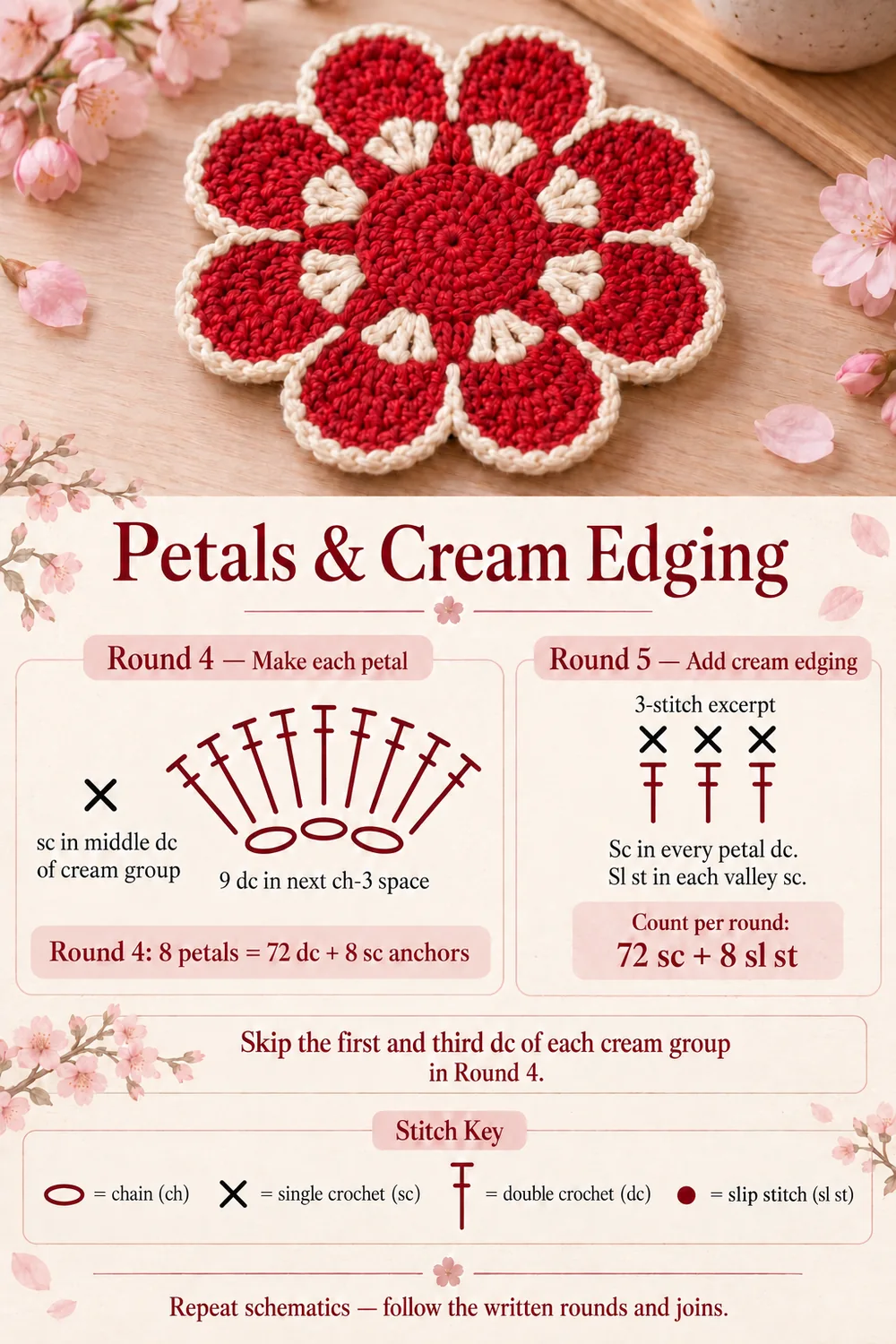
Join red with a sl st into the middle dc of any cream group. Ch 1, then sc in that same middle dc. Skip the third dc of this group, work 9 dc into the following ch-3 space, and skip the first dc of the next cream group. This completes the first petal and brings you to the next middle dc.
Repeat [sc in the next middle dc, skip the next dc, 9 dc in the next ch-3 space, skip the next dc] seven more times. On the final repeat, the last skipped stitch is the first dc of the starting cream group. Join with a sl st to the first red sc. Fasten off red.
Count: 8 sc anchors and 8 shells containing 72 dc. Each cream group receives one sc in its middle dc; its other two dc are skipped. Each cream ch-3 space receives exactly one nine-dc shell. The sc sits in a valley, while the nine dc make a rounded lobe.
Spread each shell gently along its chain arch without pulling the arch wider. If a shell seems unusually narrow, count its dc before continuing. A missing dc can be difficult to see after the cream edge has been added.
Round 5: outline the petals in cream
Join cream with a sl st to the first dc of any red shell. Ch 1 and sc in that same dc, then sc in each of the next 8 dc. Sl st in the following red sc anchor. Repeat [sc in each of the next 9 dc, sl st in the following sc anchor] seven more times. Join with a sl st to the first cream sc and fasten off.
Count: 72 sc and 8 valley sl sts. The color-attachment slip stitch and final joining slip stitch are excluded. Do not add another sc in a valley: the slip stitch there keeps the dip lower than the petal edge.
The border adds one sc per red petal dc without increases. Its job is to draw a narrow cream line around the existing shape. Keep your edging tension comfortable; working every valley slip stitch very tightly can make the finished flower curl.
Check the counts before weaving in the ends
| Round | Color | Finished count | Placement to check |
|---|---|---|---|
| 1 | Red | 16 dc | All into MR |
| 2 | Red | 32 dc | 2 dc per previous dc |
| 3 | Cream | 24 dc + 8 ch-3 spaces | Eight repeats across 32 base sts |
| 4 | Red | 72 dc + 8 sc | 9 dc per arch; sc in middle group dc |
| 5 | Cream | 72 sc + 8 valley sl sts | Sc in every petal dc; sl st in valley sc |
The total dc count for Round 4 is 8 × 9 = 72. The eight sc anchors are additional stitches, giving 80 working stitch tops around that round. Round 5 works into all 80 of those tops: 72 receive sc and eight receive slip stitches. No red stitches should remain unused at the end of the edging.
Finish the flower without flattening the scallops
Secure the magic-ring tail through the backs of the red center stitches, changing direction before trimming. Weave the other tails through stitches of the same color. Avoid bulky knots beneath the center, where they could create a raised spot under a glass.
If the yarn label permits damp blocking, lightly dampen the motif and arrange it on a flat drying surface. Open the eight petals evenly, keeping the cream valleys between them. Pin the outline without stretching the shells into points, and let the coaster dry fully before lifting it.
Place the intended cup or glass on the dry motif and check that its base sits steadily. If it rocks on the texture, reaches the open areas or catches an edge, use the flower as a decorative mat instead. For a different cup-supporting construction, the crochet wreath coaster uses a single-crochet center.
Troubleshooting the red and cream flower coaster
- The red center has 33 stitches: check Round 2’s starting increase. Ch 3 plus one dc makes two counted dc at the first stitch, not three.
- There are seven or nine cream arches: return to the 32-stitch foundation. Each cream repeat uses one worked base stitch and three skipped base stitches. Mark every fourth stitch before restarting if needed.
- A red petal crosses a cream group: the nine dc belong in a ch-3 space, not in the three dc of a fan group. Only the group’s middle dc receives the red sc anchor.
- The valleys have disappeared: look at Round 5. Each red sc anchor receives a slip stitch, rather than a single crochet or a small shell.
- The edge pulls inward: first check all nine dc were made in each shell. If the counts are right, remake the cream edging with looser slip stitches.
- The flower ruffles or cups: confirm the counts before blocking. If correct counts still give a distorted motif, adjust hook size or chain tension on a new sample; blocking should not be used to force severe excess fabric flat.
Make a coordinated set
Finish and check one flower before repeating it. Keep both yarn colors, the hook and your chain tension consistent across the set. Reversing the red and cream placement keeps the same stitch arithmetic, while changing the mood of the border.
For another floral construction, the Christmas flower coaster uses twelve repeats and a gold accent ring. For a larger table arrangement, see the crochet Christmas table set. This eight-petal version keeps its focus on two colors and the fine contrasting outline.
Follow your cotton yarn’s care directions, reshape the petals after washing and allow the motif to dry flat. Check the red yarn for color transfer before washing it together with light textiles.
Flower coaster images and stitch guides
The three Pin layouts below show the floral styling in different compositions. The last three images explain the red center, one cream repeat and the petal-and-edging sequence. These are schematic teaching excerpts, not tested full stitch charts. Follow the written joins and counts rather than counting stitches from the styled photographs.